

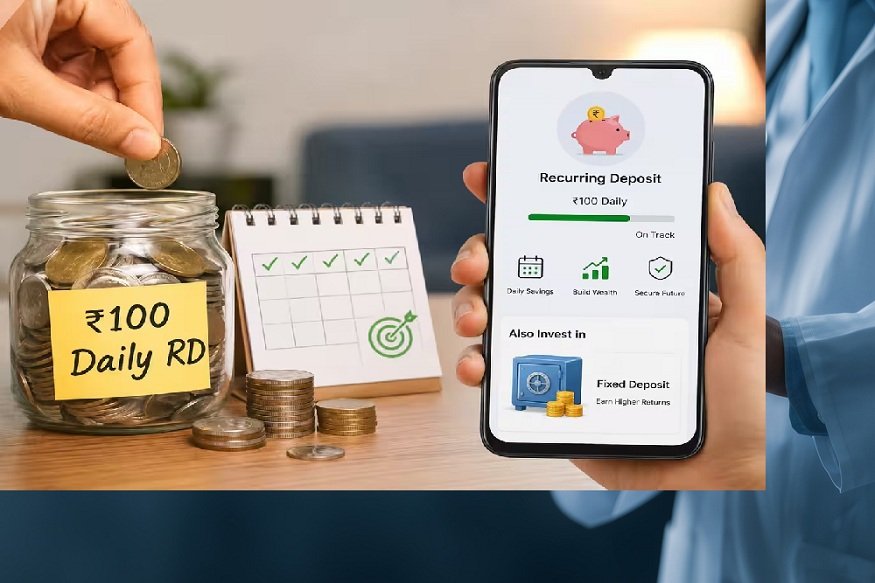
An FD saving app is best for growing a lump sum safely at a fixed rate. A savings account suits money you need any day, and a recurring deposit (RD) builds a monthly saving habit. Most households do best by using all three together, each for a different job.
How are an FD, an RD and a savings account different?
They differ in how you invest, how much you earn and how quickly you can use the money.
| Feature | Savings account | Recurring deposit | Fixed deposit via app |
|---|---|---|---|
| How you invest | Deposit anytime | Fixed monthly amount | Lump sum |
| Returns | Lowest | Similar to FD rates | Higher than savings, fixed for tenure |
| Liquidity | Instant | Penalty if broken | Penalty if broken early |
| Best for | Daily spending and emergencies | Building a habit from monthly income | Growing a lump sum safely |
| Insurance | DICGC up to ₹5 lakh per bank | DICGC up to ₹5 lakh per bank | DICGC for bank FDs; not for NBFC FDs |
These are offered by RBI-regulated banks; FDs also come from NBFCs.
When should you use a savings account?
Use a savings account for money you may need on any day.
This includes bills, groceries and the first layer of your emergency fund. A savings account gives instant access through UPI and debit cards. But it usually earns the least.
When should you use a recurring deposit?
Use an RD when you want to save a fixed amount from every month’s income.
An RD is a deposit where you pay the same amount each month for a chosen tenure. It forces consistency.
When should you use an FD saving app?
Use an FD saving app when you have a lump sum that you will not need for a set period.
Good examples are a bonus, built-up savings or a maturing RD. Moving idle money from a savings account into an FD can raise what it earns.
How can you combine all three in one plan?
You can combine them by giving each tool a clear role.
- Keep two to three months of expenses in a savings account.
- Run an RD from your salary each month.
- When the RD matures, move it into an FD through an FD saving app.
Key Takeaways
- A savings account is for instant access, not for growing money.
- An RD builds discipline through fixed monthly deposits.
- An FD saving app helps a lump sum earn a fixed rate safely.
- Using all three together gives liquidity, habit and growth.
Frequently Asked Questions
Is an FD better than a savings account?
An FD usually earns more than a savings account, but it is not better for every need. FDs lock money for a tenure, while savings accounts give instant access. Keep daily and emergency money in savings, and move surplus funds you will not need soon into FDs.
Read More: Why Gold Coast Is Seeing More Apartment Building Development
Do RD and FD give the same interest?
RD interest rates are generally similar to FD rates for the same tenure. However, in an RD you deposit money monthly, so the full amount does not earn interest for the whole period. An FD invests the full lump sum from day one.
Are NBFC FDs covered by DICGC insurance?
No, NBFC FDs are not covered by DICGC insurance. DICGC covers bank deposits up to ₹5 lakh per bank. Check an NBFC’s credit rating, interest rate and withdrawal terms before investing in its fixed deposits.
Can I break an FD booked on an app?
Yes, most FDs booked on an FD saving app can be broken early, subject to the issuer’s rules. Premature withdrawal usually attracts a penalty or a lower rate. Check the withdrawal terms carefully before you book.
Read More: Why Do Home Loan Rates Change but Your FD Rate Does Not?
Conclusion
The smartest savers use a savings account, an RD and an FD saving app together. The JioFinance App brings these closer. It offers a zero-balance digital savings account from Jio Payments Bank for everyday money. Its FD marketplace lists deposits from multiple banks and NBFCs, with filters by interest rate and tenure and clear tax, lock-in and withdrawal terms. A unified dashboard tracks every FD with maturity reminders. Download the JioFinance App to give every rupee the right job.